No. 1
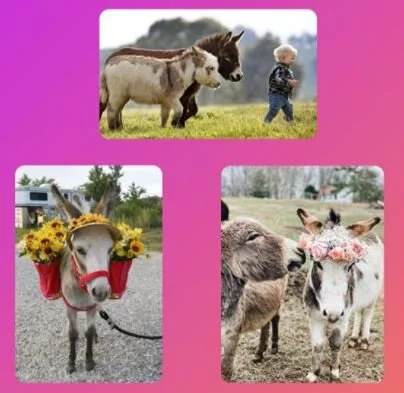
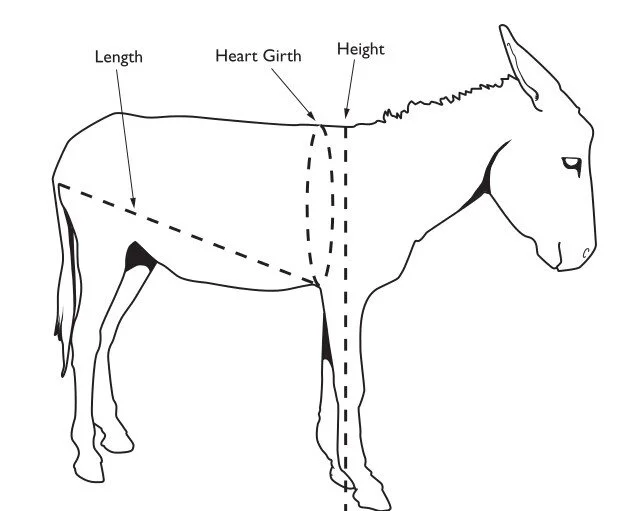
Mini Donkeys are no more than 36” tall, measured at their withers (highest point on their back).
Bonus Fact: Average weight can range from 200-450lbs.
No. 2
Donkey Terms
Asino: Italian word for donkey
Ass: An ass is either a male or female donkey
Donkey: Taken from England, the derivation is uncertain, but most authorities think that the names comes from dun (the unusual color) and the suffix “ky”, meaning small. Thus “a little dun animal”.
Burro: Spanish word for donkey
Jack: a male donkey
John: an informal term for a castrated male donkey (gelding)
Jenny (or jennet): a female donkey
Molly: a female mule
Hinny: the result of breeding between a female donkey and male horse
Mule: the result of breeding between a male donkey and a female horse
Mule Jack: not a mule, but a jackass used to breed mares to obtain mules
No. 3
Types of Modern Donkeys
Miniature Mediterranean Donkey: Originally imported from the islands of Sicily and Sardinia, and other Mediterranean areas, these donkeys must be under 36” at the withers at maturity (after age 3).
Standard Donkey: This covers the size range of most donkeys in the world. The size range is from 36.01” to 48” at the withers. This size donkey is often called “burro”. (Most but not all of the background is Spanish stock.)
Large Standard Donkey: Donkeys from 48.01” up to 54” for females and up to 56” for males. These are good riding donkeys or can be used in breeding saddle mules. Many may have Mammoth breeding in their background.
Mammoth: Mammoth Jackstock; this is one of the largest breeds of donkey in the world. Once referred to as American Standard Jack Stock. Males must stand 56” and up, females must be 54” and up.
American Spotted Ass: While all asses can come in the spotted pattern (“pinto”), the term American Spotted Ass is a trademark for those donkeys (asses) registered with the American Council of Spotted Asses (ACOSA), which is trying to establish foundation stock for spotted asses.
Donkeys are used as guard animals for goats and sheep against the threat of coyote attack. They are also used to protect cows while calving.
The coyote is the only natural threat to donkeys. Donkeys therefore do note like any canines.
No. 4
Donkeys need a three-sided loafing shed for protection against the cold north winds of winter and the hot sun of summer.
Do not be surprised if a donkey doesn’t use shelter at times when you think he should. He knows when to seek protection and when to just enjoy the rain.
No. 5
You can train a donkey with a combination of clicker training and operant conditioning to shape increasingly complex behaviors.
No. 6
Wild donkeys originally are desert animals (think Africa to the Arabian Peninsula and in the middle east).
They love dirt, and their favorite pastime is rolling in it to deter bugs/flies.
No 7.
No. 8
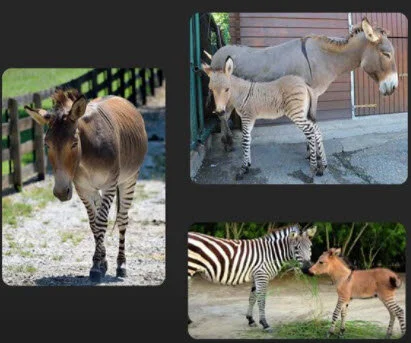
In addition to other donkeys, they will breed with horses and zebras. The offspring are hybrids of two types of Equidae. We already went over the terminology of mule and hinny in Fact No. 2 of this series.
But ! A mating between a zebra and a donkey produces what is called a zebroid, zonkey, or zeedonk.
Hybrids are almost always sterile and cannot produce offspring.
Donkeys are stubborn, but not for the reason you’d think. Most donkeys are “stubborn” in that they have to trust their handler very well to follow their instructions.
Also, there has to be something in it for them! If you ask them to do something that doesn’t make sense to them, or seems “stupid” in their eyes, they are likely not going to do it unless you give them a good reason.
No 9.
Domestic donkeys like hay, but barley straw is good roughage they like a lot as well. Legume hay such as alfalfa is not recommended for the same reason that lush pasture is not good for donkeys.
Some tasty treats donkeys like (that are abnormal from horses): beets, bananas WITH the peel, sage brush
Technically they’re an invasive species because they’ll eat everything - they have a sturdy digestive system and a hearty appetite.
No. 10
You’re probably familiar with the loud bray of a donkey. But did you know that there have been actual scientific studies about these hee-haws? For example, according to the Acoustical Society of America, donkeys are one of the only species that can make noise while they’re breathing in and out.
“Donkey vocalizations (…) appear to be unique among the Equidae in that significant sound is produced during both air intake (the hee) and the air outflow (the haw).”
No. 11
The current US population of mini donkeys is estimated to be from 10,000 to 20,000.
Today, imports of miniature donkeys are difficult as they are reported to be near extinction in their native area.
They were first imported to the United States in 1929.
No. 12
No. 13
The miniature donkey is a true breed, it is not bred down to size.
No. 14
Miniature donkeys are one of the most affectionate and friendly animals of their kind.
They are tame, gentle, loyal, playful, and affectionate - the perfect pet!
They’re a very social animal who likes to give and receive a great deal of attention.